Chinese Lenders Review
QFIN, XYF, JFIN, FINV

Note: I wrote this article in early June but never published it. It is still relevant, however, and since I have not seen anyone else covering these companies, I think it is worth revisiting them ahead of the upcoming Q2 results.
This week, several Chinese online lenders reported their results, so I wanted to summarize how I view the numbers and where I now stand on the sector.
Let’s start with the year-to-date stock performance.
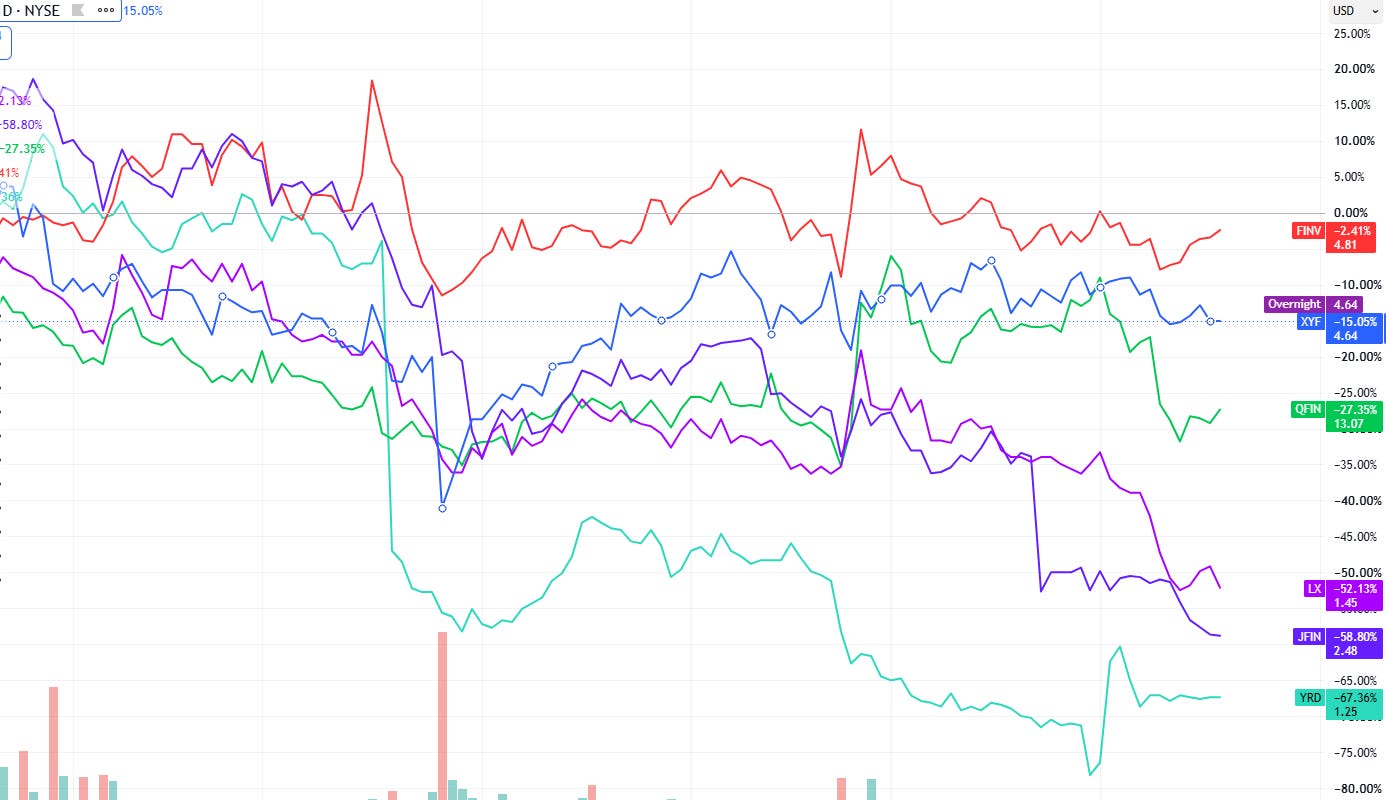
Broadly speaking, most of these stocks have performed poorly, with the exception of FinVolution, which is down only around 11%. And, honestly, given the regulatory changes that have taken place, I think some of these companies have not fallen as much as one might have expected.
Before discussing the individual company results, I will first summarize the main regulatory changes introduced since October 2025.
24% Cap on the Total Annualized Cost of Loans
The most important regulatory change introduced from 2025 onwards was the 24% annualized cap on the total cost of consumer loans.
The key point is that this cap does not apply only to the nominal interest rate. It applies to the all-in cost borne by the borrower. In other words, the 24% limit must include interest, service fees, guarantee fees, credit enhancement fees, and any other charges associated with the loan.
This directly affects the business model of fintech lending platforms, because many of them monetized part of the loan through fees or separate structures that were not always presented as explicit interest.
Greater Transparency and Mandatory Disclosure of Total Financing Costs
In March 2026, the NFRA and the PBOC issued a new policy requiring lenders and platforms to clearly disclose the comprehensive financing cost to borrowers.
For online personal loans, the disclosure form must be shown prominently to users, including mechanisms such as a non-dismissible pop-up window with a timer. The key compliance deadline is August 1, 2026.
The goal is for borrowers to clearly understand the total annualized cost of the loan before accepting it. This affects marketing, conversion rates, and the ability to sell high-cost loans in a less visible way.
For fintech platforms, this means less commercial flexibility and greater pressure on products that relied on opaque or poorly disclosed fees.
Tougher Rules for Small Loan Companies
The authorities have also tightened the rules for small loan companies, which matters because many Chinese fintech platforms use, or have historically used, micro-lending or small-loan licenses to originate or facilitate credit.
The new guidelines not only reinforce the 24% cap, but also push these entities towards a lower maximum cost linked to the LPR — specifically, four times the Loan Prime Rate, which would imply a cap of roughly 12%.
Greater Control Over Banks and Funding Partners
Another important change is that banks and financial institutions working with online platforms are now expected to take greater responsibility for risk management, underwriting, and the customer relationship.
The regulator wants to avoid a situation where banks act merely as balance-sheet providers while fintech platforms control the entire origination, pricing, and risk management process.
This trend already existed under previous regulations, but it has been reinforced in 2025–2026 as part of the broader campaign to tighten oversight of online lending.
The practical result is that banks are becoming more selective when choosing fintech partners. They are demanding stronger compliance, better risk controls, and are reducing exposure to weaker platforms.
For companies such as QFIN or FinVolution, this may be negative in the short term because it can reduce volumes and take rates. However, it could be positive over the long term if the market consolidates around the leading platforms.
For weaker companies such as X Financial, the impact could be much more severe.
Authorized Platforms and Whitelisted Partners
The new framework also pushes banks and financial institutions to work only with platforms that meet certain regulatory and operational standards. In practice, this functions almost like a whitelist of approved partners.
This accelerates sector consolidation. Platforms with scale, strong risk controls, technological capabilities, and good regulatory compliance are more likely to maintain relationships with banks and funding partners.
Smaller, more aggressive platforms, or those with weaker credit performance, may lose access to funding.
This is one of the reasons why the regulatory impact is not the same across the sector. QFIN and FinVolution appear better positioned to survive the new environment, while X Financial has suffered a much sharper contraction in originations and profitability.
Greater Oversight of Online Marketing for Financial Products
In 2026, the regulator also tightened the rules around the online marketing of financial products. Internet platforms and financial institutions are expected to promote products only within the scope of their authorized activities and to provide clear information to consumers.
This particularly affects user acquisition. Fintech platforms can no longer grow as aggressively through online traffic, promotions, or less transparent acquisition channels.
This helps explain why several companies have reduced marketing spending, prioritized higher-quality borrowers, and accepted significant declines in originations.
As we will see below, the earnings of all these companies have fallen significantly as a result of these regulatory changes.
Q1 2026 Results
Let’s go company by company. I will first present the Q1 numbers and then briefly explain how I interpret the results of each company.
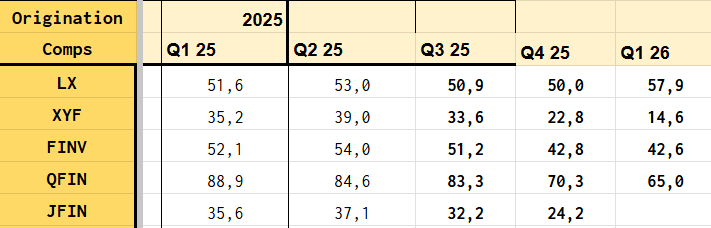
Originations, Q1 2025 to Q1 2026 (RMB billions).
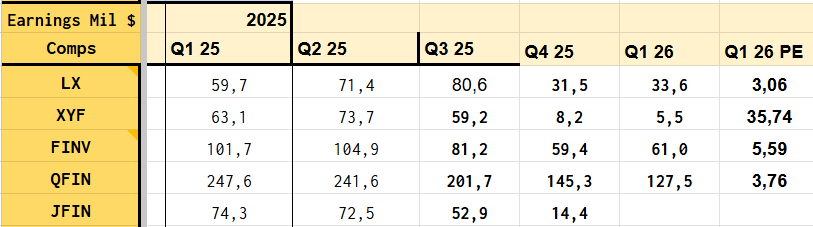
Earnings, Q1 2025 to Q1 2026 ($ millions).
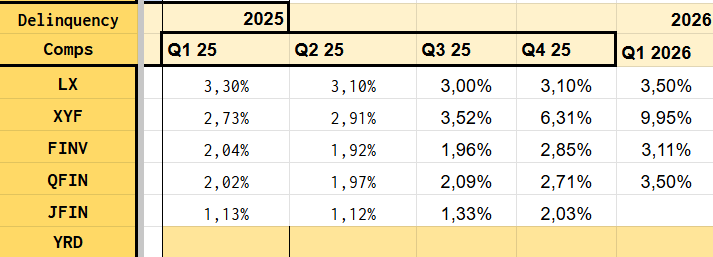
Delinquency, Q1 2025 to Q1 2026.
QFIN
QFIN
The positive: QFIN’s results came in at the high end of its guidance range. The company had guided for Q1 net income of RMB 830–880 million and reported RMB 879.8 million, effectively at the very top of the range.
Originations were slightly lower than in Q4, and earnings also declined modestly. The main negative point was that delinquency increased from 2.71% to 3.50% during the quarter. This is something that needs to be monitored.
Guidance: Q2 guidance is for net income of RMB 830–910 million, which implies that Q2 should be broadly similar to Q1, or slightly better.
Shareholder returns: QFIN did not repurchase shares during Q1, although it did repurchase around $100 million of convertible notes. In Q4, the company repurchased around $170 million of ordinary shares and also increased its semi-annual dividend to $0.78 per ADS.
If maintained, that implies an annual dividend of $1.56 per ADS, or almost a 10% dividend yield at the current share price.
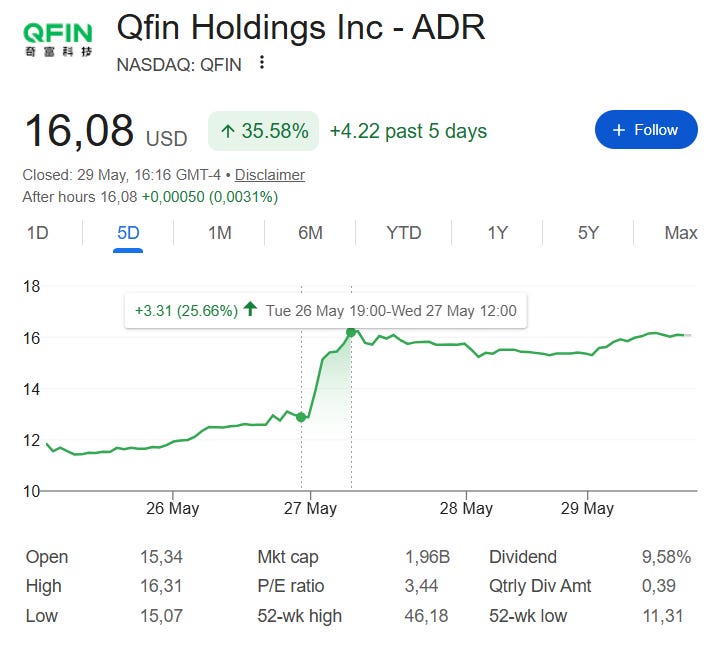
The stock rose 25% on the day of the results, which surprised me. That said, I do think the stock had fallen significantly despite QFIN being a higher-quality business than some other companies in the sector, such as XYF or JFIN, where the decline in the share price seems easier to justify.
FINV
The positive: FinVolution’s earnings increased compared to Q4 2025, from $59.4 million to $61 million. Its delinquency ratio rose from 2.85% to 3.11%, but the increase was smaller than for several other companies in the sector.
The international segment continues to grow at a very strong pace, around 40% year-over-year. It now represents almost one-third of FinVolution’s revenue.
However, only around 7% of operating profit comes from the international business, which means the company’s earnings remain heavily dependent on China.
Guidance: FinVolution maintained its 2026 revenue outlook of RMB 11.5–12.9 billion. For comparison, 2025 revenue was RMB 13.6 billion.
That said, these revenue figures are not especially informative on their own. Margins could be significantly lower, and if a larger share of revenue comes from the international segment, similar revenue could still translate into much lower net profit.
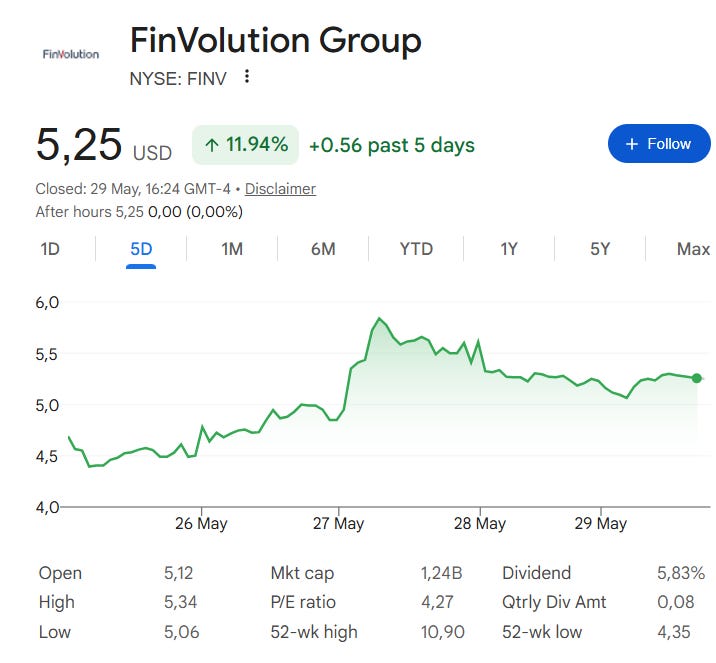
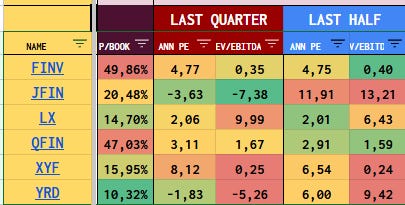
Based on annualized Q1 earnings, the company trades at roughly 5x earnings.
Shareholder returns: FinVolution repurchased around $40 million of shares during Q1. The company also increased its annual dividend to $0.306 per ADS, equivalent to a 5.8% dividend yield, and announced a new $150 million buyback program.
XYF
The positive: if I had to highlight something positive, I would say I am surprised that X Financial managed to avoid an accounting loss this quarter. That said, given that this is a financial company, I would be cautious about relying too heavily on reported earnings.
Beyond that, both Q1 and Q4 results were frankly weak.
Delinquency has surged to 9.95% for loans 91–180 days past due. The one positive point is that delinquency for loans 31–60 days past due declined from 2.9% in Q4 2025 to 2.61% this quarter.
This suggests that, although delinquency has worsened for older loans, the company is now focusing on higher-quality borrowers.
However, achieving this has required a major sacrifice: the company has lost a large part of its business. Originations in Q1 2026 were less than half the level of Q3 2025.
Guidance: guidance is also poor. The company expects to originate RMB 11.5–12.5 billion in Q2 2026, compared with RMB 14.6 billion this quarter, which was already a very sharp decline.
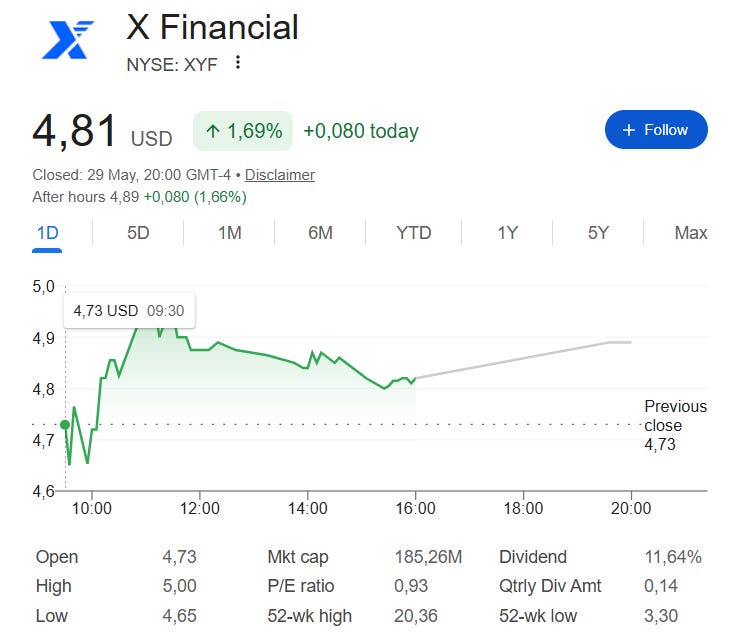
Shareholder returns: XYF repurchased $8.2 million of shares in Q1. Given the decline in the share price, this is not insignificant — it represents almost 5% of the market cap in a single quarter.
The company had previously increased its semi-annual dividend to $0.28 per ADS, which would imply an approximate 11% yield if maintained.
My main criticism of XYF is that the company repurchased a large number of shares near the stock’s peak, while buybacks have been much smaller now that the share price has collapsed.
To put numbers on it, from Q1 to Q3 2025, XYF paid $67.9 million to repurchase 4.26 million ADS, at an average price of almost $16 per share. Now that the stock trades at less than one-third of that price, the company is repurchasing far less.
Overall, although XYF was previously my main position among the Chinese lenders, I no longer find it attractive.
The regulatory changes have affected XYF particularly severely, and for now, the company does not seem to be recovering.
XYF historically lent to lower-quality borrowers, which explains why its delinquency ratios have consistently been higher than those of higher-quality platforms such as QFIN or FinVolution.
To serve those lower-quality borrowers, XYF had to charge interest rates above the current 24% regulatory cap. What we are seeing now is that a large part of XYF’s previous customer base is no longer economically viable under the new regulatory framework.
On top of that, implementing multiple regulatory changes in a short period is more burdensome for smaller companies such as XYF, which do not have the same customer base or scale to absorb compliance costs.
Finally, stricter oversight of the institutions that banks are allowed to work with also hurts XYF more. As a smaller platform that served riskier borrowers, it may find it harder to maintain access to funding partners that do not want to take on that kind of risk.
Technically, given how cheap XYF is on a price-to-book basis — around 0.17x book value — the company could repurchase a very large portion of its shares and return significant capital to shareholders.
But that requires confidence that management is willing to act aggressively in shareholders’ interests. Given the recent, relatively modest buybacks, I am not sure that confidence is justified.
I also have doubts about how much XYF’s operating business is worth in the current environment, where the Chinese regulator has become increasingly hostile and appears intent on structurally reducing the cost of consumer credit.
JFIN
Overall, JFIN’s results were genuinely poor. The company reported an accounting loss in Q1, although at first glance the results may not look quite as disastrous. Originations declined sharply, from RMB 35.6 billion in Q1 2025 to RMB 19.3 billion, representing a loss of almost 50% of its volume. On the other hand, delinquency levels remained relatively well controlled compared with other companies, with the 90-day-plus delinquency ratio standing at 2.25%.
The company’s outlook, however, is horrible. For Q2 2026, transaction volume is expected to be between RMB 9.5 billion and RMB 10.5 billion. This would represent a decline of around 50% quarter over quarter and almost 75% year over year. Considering that Jiayin already reported an operating loss in Q1, Q2 is likely to be a real disaster. It also raises the question of whether Jiayin’s business is viable with such a significantly reduced loan base.
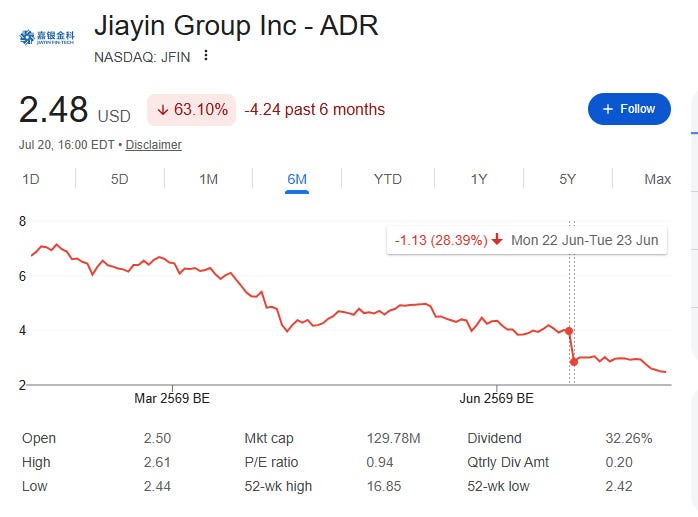
The share price fell 28% on the day of the results. Even so, given how poor the Q2 outlook is, I still consider the stock too risky to buy.
For comparison, here is a table with the current valuations of the companies (as of 21st of July).
Potential Future Regulatory Changes
Beyond the changes introduced in October 2025, it appears that further regulatory tightening may already be underway this year.
For example, on March 15, the NFRA and the People’s Bank of China issued a new policy requiring lenders to disclose all financing costs before August 1.
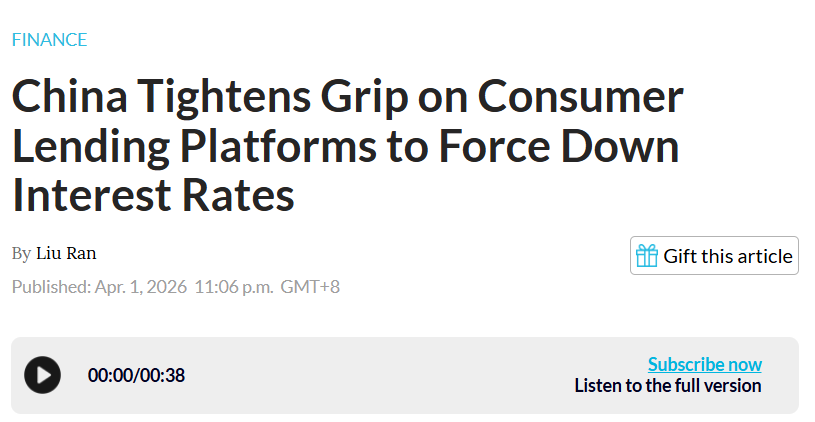
In addition, the October 2025 measures introduced a 24% financing cap, but according to this article, that cap may already be moving towards 20%. Some regional firms have reportedly even been told that they need to reduce financing costs to 18%.
Therefore, even if there is not yet a formal law replacing the 24% cap, the regulator already appears to be pushing rates significantly lower.
According to the article, some industry participants believe the long-term objective is to cap interest rates on these types of loans at four times the Loan Prime Rate.
The LPR is currently around 3%, which would imply a cap close to 12%. The objective would be to gradually bring rates down to that level by the end of 2027, while substantially reducing the share of loans above 12% by the end of 2026.
The article explicitly mentions QFIN, Lexin, Jiayin, and Yiren. Therefore, these appear to be very specific regulatory changes that could directly affect these companies as soon as this year.
Final Conclusion
All of this makes me think about the terminal value of these companies if regulatory pressure remains this intense.
If the cap moves from 24% towards 12%, margins will compress dramatically. Many of the loans originated by QFIN, FinVolution, and other platforms would simply no longer be profitable.
In that scenario, a meaningful part of the market would not just become less attractive — it could disappear altogether.
Although these companies may look optically cheap, I no longer think they are necessarily cheap if the regulator is going to be this aggressive.
This is the main change in my thinking compared with a few months ago, when I wrote my article at the beginning of the year.
Back then, I thought the regulator would take a more pragmatic approach. Since China wanted to support consumption, I expected the regulatory changes to be relatively mild, or at least milder than what the market seemed to be pricing in.
But if the current direction continues — with a 24% cap on the total annualized cost of credit and the possibility of eventually moving closer to 12% — the profitability of these companies will fall sharply.
This is not simply a case of earnings being somewhat lower. A significant part of the market these companies serve could become structurally unprofitable, because many borrowers would no longer generate acceptable returns under the new framework.
In that context, I no longer think these companies are as attractive as they once appeared.
Even if they trade at 3–5x current earnings, it is quite possible that in five or ten years these businesses will be far less profitable, or that a significant part of their business model will have been impaired by regulation.
For that reason, I prefer to be more cautious. Personally, I only hold a small position in QFIN, and for now I intend to keep it that way.
I want to wait and see whether these regulatory changes are truly implemented as aggressively as they currently appear, or whether the regulator eventually adopts a more pragmatic approach and allows for a more gradual transition.
My thesis has changed.
Previously, I thought the market was overestimating regulatory risk and that these companies could remain very profitable businesses, albeit at lower valuation multiples.
Now, I think the risk is more serious. If the regulator wants to structurally reduce the cost of consumer credit, these companies will not only face lower growth, but also lower margins, lower volumes, and probably lower structural profitability.
In short, these companies may still look cheap based on current earnings, but I am no longer convinced that they are cheap once earnings are normalized under a much tougher regulatory environment.
On a personal note, and despite having been very bullish on XYF in the past, I have sold my entire position. At this point, I believe that smaller lenders are simply too risky, and that, in a more hostile regulatory environment, their operating businesses could be worth close to zero.
Reflection on Buying Cheap Companies
Even so, despite all of this, and despite the fact that the investment may not have played out as well as I expected, there is one positive lesson I take from the situation: the value of buying cheap companies.
In the case of X Financial, for example, almost everything has gone worse than I expected.
Earnings have deteriorated significantly, the business has contracted, originations have fallen sharply, and the regulatory outlook is much worse than it appeared at the beginning of the year.
And yet, the stock is only down around 17% year-to-date.
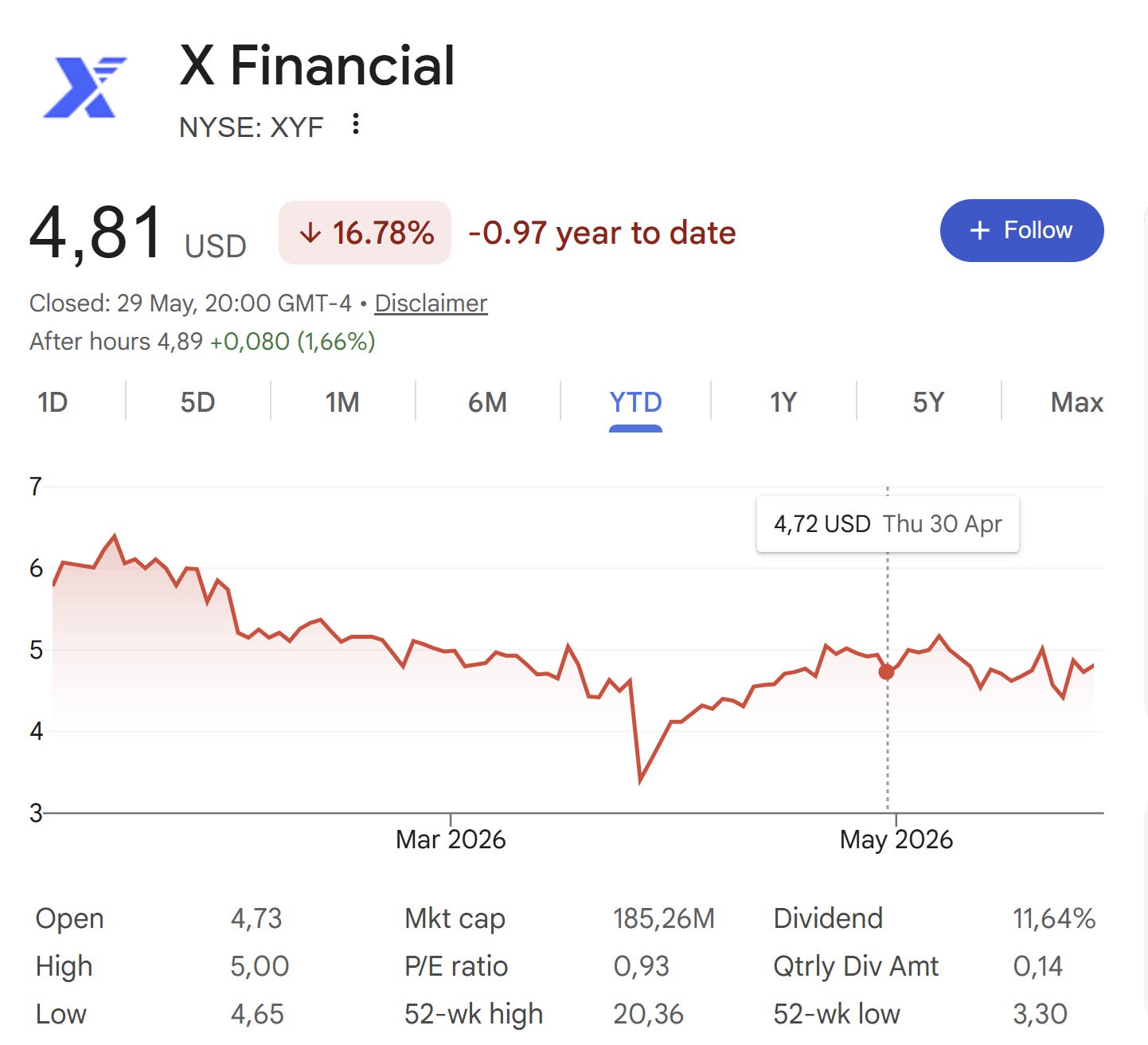
If a company with a more demanding valuation had suffered a similar deterioration in earnings, business performance, and regulatory outlook, the share price decline would probably have been much larger.
Instead, because XYF started from such a depressed valuation, part of the damage was already priced in.
Therefore, even though the investment has not gone as I expected, I do think this case illustrates one of the advantages of buying cheap companies: even when the thesis deteriorates materially, valuation can provide some downside protection.
That obviously does not prevent you from losing money. But it can significantly limit the downside if the stock was already trading at extremely depressed multiples.
Buying cheap does not protect you from being wrong, but it can make the cost of being wrong much lower.
If you’d like to receive articles for free, feel free to subscribe, and I’d really appreciate it if you shared the article. You can also follow me on Twitter:
https://x.com/NateValuetw
what about Lexinfintech and YRD which have different businesses next to the lending businesses?